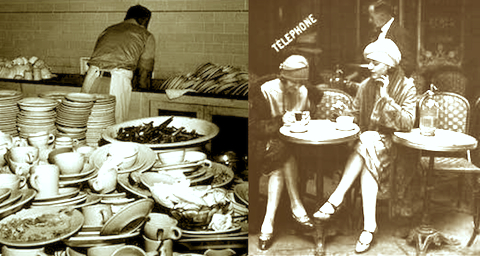
I recently had the pleasure of reading Down and Out in Paris and London by George Orwell last weekend. Published in
1933, the book chronicles the author’s unfortunate descent into the throes of
poverty in the early 1900s. After reading it, I could actually understand where
Orwell got his inspiration for writing Animal Farm.
Orwell had no choice but to become a plongeur (dishwasher/janitor) in seedy
Paris brasseries after months of not finding work. “It’s modern day slavery,”
he would say. As if his troubles were not enough, he found himself homeless and
once again unemployed when he came to London. For a month he lived the life of
a “tramp,” the equivalent of a “taong grasa” or beggar in our society, existing
on meal tickets and mercy from government houses or “London spikes.”
Reading about European poverty and famine is
strange to me. Perhaps it’s because I never really thought Western
civilizations could be that “poor” (I believe you have to see poverty from my
side of the planet for you to understand what I mean). Nevertheless, I still thought their system of
dealing with homeless vagrants has become the world’s model for treating people
who have fallen into the poverty line.
The idea that you become less than human once
you cannot afford basic necessities disturbs me. You become a pest; people
ignore you or see you as a burden in society. Foul and unproductive creatures
like you are segregated from the public. No one can be bothered to care. You
can no longer socialize and it’s terrifying to lose all self-respect. People
blame you for being poor.
(Condescending attitudes towards the poor are
all too familiar. Why is this still happening? Do people even bother to understand? I detest how
our individual worth is constantly being measured by our purchasing power. Sure,
you have to work hard. Orwell had a streak of bad luck, yet he got out of his
rut. But what about the uneducated? Those who lost the birth lottery? Is it
really their fault if they are born poor, if they cannot change their status? These
are just some of the many things I had to ponder on while going through every
chapter. The idea that it’s a person’s fault if he is poor is in itself a ploy
to keep one from being simple.)
 |
Plongeur's Life
|
 |
| A homeless man asleep on newspapers in Paris (circa 1935) |
Upon reading Down and Out, I began to have
profound respect for people who live a hand-to-mouth existence. At the same
time, I appreciate knowing that kind people can still exist among the poor, and
that there are those, though few, who are able to cultivate intellectual and
moral lives despite their harsh dispositions.
The book also reminded me of my graduate school
sociology class. My professor began that semester with the history of capitalism
and the end of slavery. She then moved on to issues concerning minimum wage
work, sweatshops and domestic employment, undocumented immigrants, and
unsustainable business models. Our class problematized how civilizations were built on the sweat of
billions of minimum wage workers.
Because everything affects everything else, we
have to start seeing life on this planet in its entirety. That means making
life better from the very bottom up, not just up. A change must occur to
address the very root of the problem. And unless people in influential
positions actually care about the common man, progress is only for the middle-class
and the privileged.
On a more personal note, I realized how
important it is to keep our inner lives alive. This goes for all of us, not
just for people struggling with poverty. It’s so easy to lose ourselves in need
and greed when all we ever think about is our place in society. We have to
realize we are more than our desires, needs, and what others see.
--
There is a lot to learn from the past. I find
the following chapter very relevant when it comes to 1) workers rights, 2) how
we utilize our skills, and 3) how society’s elite fails to sympathize with the
working class and the poor. I would have quoted lines, but the entire essay
just has to be read in its full form.
Chapter XXII
Down and Out in Paris
and London, 1933
By George Orwell
For
what they are worth I want to give my opinions about the life of a Paris
PLONGEUR. When one comes to think of it, it is strange that thousands of people
in a great modem city should spend their waking hours swabbing dishes in hot
dens underground. The question I am raising is why this life goes on—what
purpose it serves, and who wants it to continue, and why I am not taking the
merely rebellious, FAINEANT attitude. I am trying to consider the social
significance of a PLONGEUR’S life.
I
think one should start by saying that a PLONGEUR is one of the slaves of the
modem world. Not that there is any need to whine over him, for he is better off
than many manual workers, but still, he is no freer than if he were bought and
sold. His work is servile and without art; he is paid just enough to keep him
alive; his only holiday is the sack. He is cut off from marriage, or, if he
marries, his wife must work too. Except by a lucky chance, he has no escape
from this life, save into prison. At this moment there are men with university
degrees scrubbing dishes in Paris for ten or fifteen hours a day. One cannot
say that it is mere idleness on their part, for an idle man cannot be a
PLONGEUR; they have simply been trapped by a routine which makes thought
impossible. If PLONGEURS thought at all, they would long ago have formed a
union and gone on strike for better treatment. But they do not think, because
they have no leisure for it; their life has made slaves of them.
The
question is, why does this slavery continue? People have a way of taking it for
granted that all work is done for a sound purpose. They see somebody else doing
a disagreeable job, and think that they have solved things by saying that the
job is necessary. Coal-mining, for example, is hard work, but it is
necessary—we must have coal. Working in the sewers is unpleasant, but somebody
must work in the sewers. And similarly with a PLONGEUR’S work. Some people must
feed in restaurants, and so other people must swab dishes for eighty hours a
week. It is the work of civilization, therefore unquestionable. This point is
worth considering.
Is a
PLONGEUR’S work really necessary to civilization? We have a feeling that it
must be ‘honest’ work, because it is hard and disagreeable, and we have made a
sort of fetish of manual work. We see a man cutting down a tree, and we make
sure that he is filling a social need, just because he uses his muscles; it
does not occur to us that he may only be cutting down a beautiful tree to make
room for a hideous statue. I believe it is the same with a PLONGEUR. He earns
his bread in the sweat of his brow, but it does not follow that he is doing
anything useful; he may be only supplying a luxury which, very often, is not a
luxury.
As
an example of what I mean by luxuries which are not luxuries, take an extreme
case, such as one hardly sees in Europe. Take an Indian rickshaw puller, or a
gharry pony. In any Far Eastern town there are rickshaw pullers by the hundred,
black wretches weighing eight stone, clad in loin-cloths. Some of them are
diseased; some of them are fifty years old. For miles on end they trot in the
sun or rain, head down, dragging at the shafts, with the sweat dripping from
their grey moustaches. When they go too slowly the passenger calls them
BAHINCHUT. They earn thirty or forty rupees a month, and cough their lungs out
after a few years. The gharry ponies are gaunt, vicious things that have been
sold cheap as having a few years’ work left in them. Their master looks on the
whip as a substitute for food. Their work expresses itself in a sort of
equation—whip plus food equals energy; generally it is about sixty per cent
whip and forty per cent food. Sometimes their necks are encircled by one vast
sore, so that they drag all day on raw flesh. It is still possible to make them
work, however; it is just a question of thrashing them so hard that the pain
behind outweighs the pain in front. After a few years even the whip loses its
virtue, and the pony goes to the knacker. These are instances of unnecessary work,
for there is no real need for gharries and rickshaws; they only exist because
Orientals consider it vulgar to walk. They are luxuries, and, as anyone who has
ridden in them knows, very poor luxuries. They afford a small amount of
convenience, which cannot possibly balance the suffering of the men and
animals.
Similarly with the PLONGEUR. He is a king compared with a rickshaw
puller or a gharry pony, but his case is analogous. He is the slave of a hotel
or a restaurant, and his slavery is more or less useless. For, after all, where
is the REAL need of big hotels and smart restaurants? They are supposed to
provide luxury, but in reality they provide only a cheap, shoddy imitation of
it. Nearly everyone hates hotels. Some restaurants are better than others, but
it is impossible to get as good a meal in a restaurant as one can get, for the
same expense, in a private house. No doubt hotels and restaurants must exist,
but there is no need that they should enslave hundreds of people. What makes
the work in them is not the essentials; it is the shams that are supposed to
represent luxury. Smartness, as it is called, means, in effect, merely that the
staff work more and the customers pay more; no one benefits except the
proprietor, who will presently buy himself a striped villa at Deauville.
Essentially, a ‘smart’ hotel is a place where a hundred people toil like devils
in order that two hundred may pay through the nose for things they do not
really want. If the nonsense were cut out of hotels and restaurants, and the
work done with simple efficiency, PLONGEURS might work six or eight hours a day
instead often or fifteen.
Suppose it is granted that a PLONGEUR’S work is more or less useless.
Then the question follows, Why does anyone want him to go on working? I am
trying to go beyond the immediate economic cause, and to consider what pleasure
it can give anyone to think of men swabbing dishes for life. For there is no
doubt that people—comfortably situated people—do find a pleasure in such
thoughts. A slave, Marcus Gato said, should be working when he is not sleeping.
It does not matter whether his work is needed or not, he must work, because
work in itself is good—for slaves, at least. This sentiment still survives, and
it has piled up mountains of useless drudgery.
I
believe that this instinct to perpetuate useless work is, at bottom, simply
fear of the mob. The mob (the thought runs) are such low animals that they
would be dangerous if they had leisure; it is safer to keep them too busy to
think. A rich man who happens to be intellectually honest, if he is questioned
about the improvement of working conditions, usually says something like this:
‘We
know that poverty is unpleasant; in fact, since it is so remote, we rather
enjoy harrowing ourselves with the thought of its unpleasantness. But don’t
expect us to do anything about it. We are sorry for you lower classes, just as
we are sorry for a, cat with the mange, but we will fight like devils against
any improvement of your condition. We feel that you are much safer as you are.
The present state of affairs suits us, and we are not going to take the risk of
setting you free, even by an extra hour a day. So, dear brothers, since
evidently you must sweat to pay for our trips to Italy, sweat and be damned to
you.’
This
is particularly the attitude of intelligent, cultivated people; one can read
the substance of it in a hundred essays. Very few cultivated people have less
than (say) four hundred pounds a year, and naturally they side with the rich,
because they imagine that any liberty conceded to the poor is a threat to their
own liberty. Foreseeing some dismal Marxian Utopia as the alternative, the
educated man prefers to keep things as they are. Possibly he does not like his
fellow-rich very much, but he supposes that even the vulgarest of them are less
inimical to his pleasures, more his kind of people, than the poor, and that he
had better stand by them. It is this fear of a supposedly dangerous mob that makes
nearly all intelligent people conservative in their opinions.
Fear
of the mob is a superstitious fear. It is based on the idea that there is some
mysterious, fundamental difference between rich and poor, as though they were
two different races, like Negroes and white men. But in reality there is no
such difference. The mass of the rich and the poor are differentiated by their
incomes and nothing else, and the. average millionaire is only the average
dishwasher dressed in a new suit. Change places, and handy dandy, which is the
justice, which is the thief? Everyone who has mixed on equal terms with the
poor knows this quite well. But the trouble is that intelligent, cultivated
people, the very people who might be expected to have liberal opinions, never
do mix with the poor. For what do the majority of educated people know about
poverty? In my copy of Villon’s poems the editor has actually thought it
necessary to explain the line ‘NE PAIN NE VOYENT QU’AUX FENESTRES’ by a
footnote; so remote is even hunger from the educated man’s experience.
From
this ignorance a superstitious fear of the mob results quite naturally. The
educated man pictures a horde of submen, wanting only a day’s liberty to loot
his house, burn his books, and set him to work minding a machine or sweeping
out a lavatory. ‘Anything,’ he thinks, ‘any injustice, sooner than let that mob
loose.’ He does not see that since there is no difference between the mass of
rich and poor, there is no question of setting the mob loose. The mob is in
fact loose now, and—in the shape of rich men—is its power to set up enormous
treadmills of boredom, such as ‘smart’ hotels.
To
sum up. A PLONGEUR is a slave, and a wasted slave, doing stupid and largely
unnecessary work. He is kept at work, ultimately, because of a vague feeling
that he would be dangerous if he had leisure. And educated people, who should
be on his side, acquiesce in the process, because they know nothing about him
and consequently are afraid of him. I say this of the PLONGEUR because it is
his case I have been considering; it would apply equally to numberless other
types of worker. These are only my own ideas about the basic facts of a
PLONGEUR’S life, made without reference to immediate economic questions, and no
doubt largely platitudes. I present them as a sample of the thoughts that are
put into one’s head by working in an hotel.